Foreign
Sudan’s Children Are Starving to Death While The World Watches Generals Fight

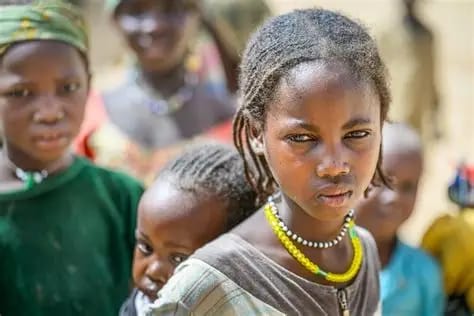
She has a name. Nour Al-Sham.
She is not a number in a UN report. She is a little Sudanese girl who has not eaten for two days. She lies in a hospital bed, her tiny body too weak to sit up, in desperate need of a blood transfusion her mother cannot afford.
Her mother told a TV crew how Nour has been hospitalized several times for malnutrition. Each time she recovers a little, the food runs out again, and she collapses again.
Nour is one. But there are millions like her. And while she fights for one more breath, the men who started this war are fighting for power.
The Horror In The Mountains: Darfur’s Forgotten Famine
On September 30, 2026, a chilling alert came from the mountains.
The General Coordination for Displaced Persons and Refugees in Darfur announced that 30 children had died in just days in Soni, in eastern Jebel Marra, from complications of acute malnutrition. More than 100 other children are in critical condition, their bodies shutting down from hunger.
And that is only what they could count.
Spokesperson Adam Rijal told Sudan Tribune that the true death toll is likely far higher. “There are no health centres. No way to monitor. No medicine,” he said.
Drought has burnt the farms. War has blocked the roads. The price of sorghum, of medicine, of a bag of rice, has tripled in months. Humanitarian aid trucks are stuck at checkpoints, turned back by soldiers who use food as a weapon.
The numbers are now apocalyptic. According to the United Nations, 825,000 Sudanese children are suffering from severe acute malnutrition — the most deadly form. Another 3.4 million children are at risk of dying from preventable diseases because there are no clinics, no vaccines, no doctors.
Newtelegraphng.com reports that in total, 33.7 million Sudanese — nearly two-thirds of the entire country — will need humanitarian assistance to survive in 2026.
The world promised to help. It has not.
The UN Food and Agriculture Organization launched a $193 million emergency plan to stop famine in Sudan. As of this week, it has received only $43 million. Less than 25 percent funded.
Why The Guns Won’t Stop
The war erupted in April 2023, when the alliance between Army Chief General Abdel Fattah al-Burhan and Rapid Support Forces leader Hemedti collapsed into street battles in Khartoum.
Three years later, Sudan is unrecognizable. Khartoum is empty. Darfur is bleeding. The state has collapsed.
Yet peace is still rejected.
Last month, the United States put a new proposal on the table — a 90-day humanitarian truce to allow food and medicine to reach millions. Al-Burhan, Chairman of the Transitional Sovereignty Council, has expressed reservations. He insists he will continue fighting until the RSF is completely defeated.
But what will be left to govern?
Newtelegraphng.com hinted that the continuation of fighting while children starve raises a brutal moral question: Are Sudan’s military leaders willing to sacrifice an entire generation for victory?
The international community has already answered that question once. In January 2025, the United States imposed direct sanctions on al-Burhan, accusing the Sudanese Armed Forces under his leadership of attacking civilians, bombing schools, markets and hospitals, deliberately obstructing aid delivery, and using starvation as a method of warfare.
The RSF is accused of equally horrific crimes — mass rape, ethnic cleansing in Darfur, looting and burning villages.
Poison Gas Allegations – The Ultimate Red Line
Now the war may have crossed the ultimate red line.
In July 2026, Washington imposed new sanctions after intelligence suggested the Sudanese Army had used chemical weapons in 2024.
Then, in September 2026, two of America’s most respected newspapers — The Washington Post and The New York Times — published damning investigations based on documents and insider sources, alleging a secret chemical weapons programme that developed and deployed chlorine-filled munitions during the war.
The Sudanese Army denies it.
Newtelegraphng.com added that if true, it would be a war crime of the highest order, and a grave breach of the Chemical Weapons Convention.
This cannot be left to denial and counter-denial. It demands an immediate, independent investigation by the Organisation for the Prohibition of Chemical Weapons. OPCW inspectors must be granted access, samples must be tested, and those responsible must be named and prosecuted.
And accountability must not stop there. It must include all grave violations — the deliberate bombing of civilians, the systematic obstruction of aid, the weaponization of hunger, and the rampant sexual violence against women and children, no matter which side committed them.
Sanctions must be surgical. They must choke the generals and their gold mines and arms networks — not the mother trying to buy blood for her daughter.
A Nation’s Future Is Being Buried
Sudan’s tragedy is no longer just a power struggle. It is the murder of a future.
While leaders fight over palaces, mothers fight over a cup of milk. While peace initiatives falter and are rejected one after another, displacement camps grow larger and cemeteries grow fuller.
Condemnation is cheap. Press statements do not feed children.
What Sudan needs today is not pity, but action: an unconditional ceasefire, safe and unhindered humanitarian access to every corner of Darfur and Kordofan, an international criminal investigation into all war crimes including chemical weapons use, and justice for victims.
One day, someone will have to explain what victory was achieved.
What victory can you declare over a country where 30 children die of hunger in one village in one week?
What victory can you declare over a country where a girl named Nour Al-Sham has not eaten for two days?




BREAKING: 8 Powerful Lawmakers Dump APC Ahead 2027

Sudan’s Children Are Starving to Death While The World Watches Generals Fight

The Economist Magazine Predicts Winner of Nigeria’s 2027 Election

BREAKING: Atiku, Peter Obi Finally Take Decision on Single Ticket Ahead 2027

BREAKING: Monday October 5, 2026 Declared Public Holiday

BREAKING: Naira Hits ₦1,767 as New Exchange Rate Emerges

Nigerians Rush to Buy as NNPC Announces New Petrol Prices Nationwide

Dollar Crashes as Exchange Rate Emerges Today, October 1, 2026

NDC Chairman Assassinated as Details Emerge
BREAKING: Court Announces Fresh APC Primary Election