
News
Senate Announces Death Penalty For Kidnappers, Informants

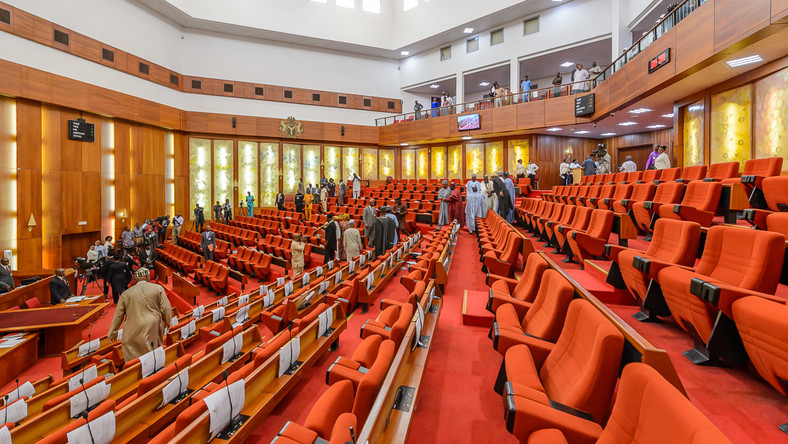
On Wednesday, the Nigerian Senate took significant steps to strengthen the nation’s anti-kidnapping laws by proposing the death penalty for kidnappers and those who finance, support, or provide information to them.
This initiative was part of the discussions regarding amendments to the 2022 Terrorism (Prevention and Prohibition) Act.
The proposal, led by Senate Leader Opeyemi Bamidele, aims to reclassify kidnapping, hostage-taking, and similar offenses as terrorism. This reclassification would empower security agencies with broader authority to track, disrupt, and prosecute criminal networks throughout the country.

The debate on this proposal was a major focus during the Senate’s plenary session, with contributions from prominent senators including Adams Oshiomhole, Orji Uzor Kalu, and Minority Leader Abba Moro.
The session was chaired by Senate President Godswill Akpabio.
After hours of deliberation, the Senate unanimously approved the amendment bill for further legislative work and referred it to the Committees on Judiciary, Human Rights and Legal Matters (lead committee), National Security and Intelligence, and Interior.

The committees are expected to report back within two weeks.
Leading debate on the bill, Bamidele said the purpose was to “designate kidnapping, hostage-taking and related offences as acts of terrorism and prescribe the death penalty for such offences without option of fine or alternative sentence.”
He warned that kidnapping had evolved into “coordinated, commercialised and militarised acts of violence perpetrated by organised criminal groups.”
“Kidnapping has instilled widespread fear in communities; undermined national economic activities and agricultural output; interrupted children’s education; bankrupted families forced to pay ransom; overstretched our security forces, and claimed countless innocent lives,” the Senate leader lamented.
According to him, the patterns of brutality associated with kidnapping “now carry all the characteristics of terrorism,” making it necessary to treat the offence under the counter-terrorism framework.
Bamidele added that the bill would empower security agencies with “broader operational authority, intelligence capabilities, and prosecutorial tools” to pursue terrorists and their enablers.
He stressed that the death penalty would apply not only to kidnappers but also to “their informants, logistics providers, harbourers, transporters, and anyone who knowingly assists, facilitates, or supports kidnapping operations,” adding that “attempt, conspiracy or incitement to kidnap attracts the same penalty.”
“Nigerians are kidnapped on highways, in schools, in homes, on farms and in markets,” he said. “This is not a mere crime. It is terrorism in its purest form.”
Backing the amendment, Oshiomhole criticised deradicalisation programmes for terror suspects, arguing that many offenders returned to crime.
“We should not continue with deradicalisation programmes again,” he said. “No more de-radicalisation. If you are caught and convicted for acts of terrorism, then the penalty should be death.”
Kalu also supported the bill, insisting that informants and sponsors of kidnappers must “face the consequence.”
“Nigerians have suffered at the hands of kidnappers. Young girls have been raped. Women have become widows for no reason. This must not continue again,” he said.
Senate Minority Leader Moro described the bill as “a unanimous decision of the Senate,” noting that it was necessary to impose capital punishment “with the hope that kidnappers will face the penalty.”
Senator Victor Umeh, in his contribution, condemned the rising trend of abductions and the killing of victims even after ransom payments. He said financial institutions aiding such crimes must also be scrutinised.
Last week, the Senate took a similarly tough stance as it debated a motion following the November 18 attack on Christ Apostolic Church, Eruku, in Ekiti LGA of Kwara State, where gunmen killed two worshippers and abducted 38 others.
Although all victims were later rescued, lawmakers said the incident exposed the spread of insurgent cells into the South and worsening insecurity in rural communities.
The debate stemmed from a motion by Senator Yisa Ashiru titled ‘Urgent Need to Address Escalating Insecurity in Kwara, Kebbi, and Niger States and Strengthen National Security Frameworks.’
Senators also raised concerns over rising school abductions, which have led to shutdowns in parts of Kebbi, Niger, Kwara, and all 47 Federal Unity Colleges nationwide.
The latest amendment effort signals a tougher legislative push as insecurity — particularly kidnapping for ransom — continues to devastate communities across the country.




Govt Bans POS, Motorcycles, Others; Gives Reason

Iyabo Obasanjo Returns to PDP; Full Details Emerge

APC Reject Speaker’s Emergence as 2027 Guber Candidate

Kano NDC Governorship Candidate Picks Kwankwaso as Running Mate

Actor Baba Ijesha Welcomes Baby Boy

Atiku Talks Tough on Removing ADC from 2027 Ballot, Takes Next Action

Nigerian Gov Declares Fresh Public Holiday; Details Emerge
![ADC Primary: Atiku Leads In Eight States As Results Trickle In [See Breakdown Of Results]](https://thepapers.ng/wp-content/uploads/2026/04/ADC-Logo-80x80.webp)
Tension as Court Finally Orders INEC to Take Fresh Action on ADC

Fresh Trouble as PDP Wins 20 Local Govt Election in APC State

Senate Tensions Rise Over Allegations Involving Akpabio, NNPC
