Spotlights
Former President Sentenced to Life in Prison

South Korea’s former President Yoon Suk-yeol has been found guilty of masterminding an insurrection and sentenced to life in prison over his imposition of short-lived martial law in 2024.
“The declaration of martial law resulted in enormous social costs, and it is difficult to find any indication that the defendant has expressed remorse for that,” Presiding Judge Ji Gwi-yeon told the court on Thursday.
“As to defendant Yoon Suk-yeol, the crime of insurrection leadership is established,” the judge said.
“We sentence Yoon to life imprisonment.”
The Seoul Central District Court ruled that Yoon was the leader of the December 3, 2024 insurrection in a case where prosecutors had sought the death penalty for the disgraced ex-president, who was impeached and removed from office over his declaration of martial law.
The court found that the core fact of Yoon’s martial law case was that he sent the military to the National Assembly in December 2024, South Korea’s Yonhap news agency reported.
The court also ruled that Yoon intended to prevent and paralyse the National Assembly from functioning properly for a significant period of time, but rejected the special prosecutor’s claim that Yoon planned to establish a long-term dictatorship, according to Yonhap.
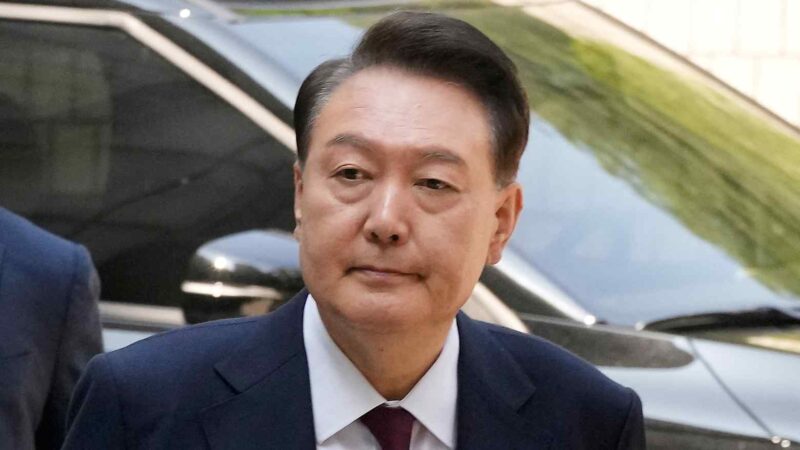
Yoon, 65, had maintained his innocence throughout his court appearances, arguing that he had the authority to declare martial law as president and that his decision was aimed at preventing opposition political parties from obstructing the government’s work.
Appeals likely
A heavy security presence surrounded the Seoul Central District Court with police buses forming a tight cordon around the court, blocking surrounding streets as officers stood guard against possible unrest.
Prosecutors accuse Yoon of abusing his authority when he ordered troops to enter parliament and remove political opponents during his short-lived declaration of martial law.
Yoon remains in custody at the Seoul Detention Centre and is expected to stay there regardless of Thursday’s decision.
Following the court’s decision, Yoon’s lawyers said the ruling had only affirmed a “pre-written script” and claimed that it was not supported by evidence in the case, without elaborating.
His lawyers added that they would be discussing with Yoon whether or not he wanted to appeal.
Al Jazeera’s Jack Barton, reporting from Seoul, said, “This verdict is really bringing to a close, at least until the appeal, this period of political turmoil following the martial law that led to months of street protests and led to the national assembly impeaching him.
“Yoon was the first sitting South Korean president to be arrested, second to be successfully impeached and the third to face trial over insurrection,” he added.
Judicial guidelines state that first-instance trials should conclude within six months, and the full appeals process within two years. In practice, politically sensitive cases often extend well beyond those timelines.
Yoon’s legal troubles stretch beyond the current proceedings. In January, a separate court sentenced him to five years in prison after convicting him of obstructing authorities who sought to arrest him following his martial law order. He has appealed that ruling.
Although his attempt to impose martial law lasted only about six hours before parliament voted it down amid mass protests, the move rattled South Korea, Asia’s fourth-largest economy and a key United States ally. The episode also raised questions about the resilience of a country long regarded as one of the region’s most stable democracies.
President Lee Jae Myung, who won a snap election in June after Yoon’s removal, praised the public’s response.
“It was possible because it was the Republic of Korea,” Lee wrote on X, invoking the country’s official name. He added that the Korean people would stand as an example in human history.
Lee attached his post to a report noting that some academics have proposed nominating the South Korean public for a Nobel Peace Prize for resisting martial law without violence.




Govt Declares Wednesday 23rd September 2026 Public Holiday Nationwide; Gives Reason

Fuel Price Reduced as Dangote Announces New Pump Rates

Dollar to Naira Exchange Rate Today, September 21, 2026

Petrol Prices Drop as Filling Stations Cut Pump Rates

Fresh Fuel Prices Emerge Nationwide as Nigerians See Changes in Petrol Costs

2027: Five APC Govs Secretly Supporting NDC
Govt Declares Monday, September 21 Public Holiday
BREAKING: Popular APC Chieftain Assassinated (PHOTO)

Dollar to Naira Exchange Rate Today, September 16, 2026

INEC Releases Numbers of Parties For Saturday’s Election