
Spotlights
Danger Zones: States That Could Shock the Presidency

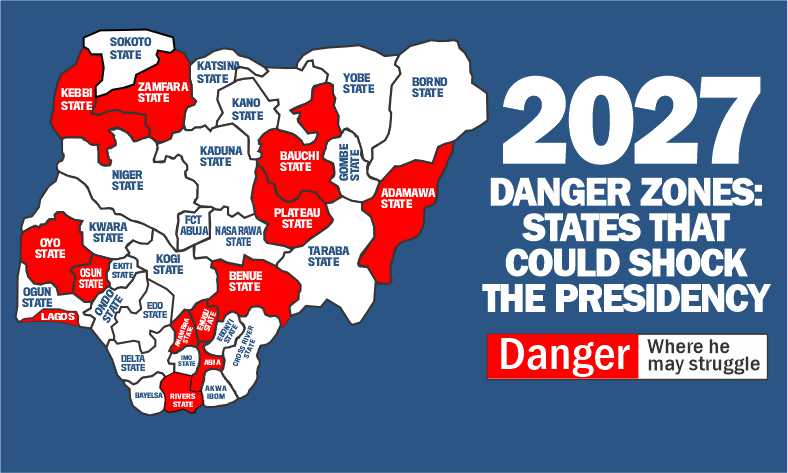
As Nigeria approaches the 2027 general election, the re-election prospects of President Bola Ahmed Tinubu are becoming a hot topic of political discussion. The Political Desk at ThePapers takes a closer look at the potential pitfalls facing the incumbent president.
While incumbency traditionally offers advantages—control of party machinery, visibility, and federal influence—it does not guarantee electoral comfort.
The 2023 election shattered long-held assumptions about regional loyalty, voter behavior, and the dominance of established parties. Those fault lines are likely to widen by 2027.

Several states stand out as potential pressure points—places where Tinubu may struggle to retain support or where opposition forces could significantly weaken his vote share. This is not a forecast of defeat, but a political reading of trends, sentiments, and unresolved tensions.
The Southwest Is No Longer Monolithic
Perhaps the most striking lesson of 2023 was that Tinubu’s home region is no longer a guaranteed fortress. Lagos State, his political stronghold, revealed deep cracks. Though he won, the margin shocked the APC establishment. Youth discontent, urban hardship, and lingering resentment from the ethnicized tone of the last election cycle have changed Lagos from a safe haven into a competitive battleground.

In Oyo State, Governor Seyi Makinde’s firm grip and the PDP’s entrenched structure remain formidable. Tinubu’s performance there in 2023 was underwhelming, and unless federal governance delivers tangible economic relief, Oyo may continue to drift away from APC influence.
Osun State, currently under PDP control, presents another challenge. Internal APC divisions and unresolved grievances from past administrations have dampened Tinubu’s appeal. The state reflects a broader truth: Southwest loyalty to Tinubu is no longer automatic—it must be earned.
The Southeast Remains Resistant
If the Southwest shows cracks, the Southeast remains largely closed territory for Tinubu. States like Anambra, Enugu, and Abia continue to display deep skepticism toward the APC. The Labour Party’s rise in 2023 reshaped political identity in the region, particularly among young voters. While APC has attempted outreach, grassroots penetration remains shallow.
In Abia, Labour Party momentum has not faded, and APC lacks the organizational depth needed to mount a serious challenge. Enugu, a long-standing PDP stronghold, continues to deliver overwhelming anti-APC votes, while Anambra remains dominated by APGA and Labour Party structures hostile to Tinubu’s brand of politics.
The Middle Belt Question
The Middle Belt could prove decisive in 2027. Plateau and Benue States reflect growing frustration over insecurity, farmer-herder conflicts, and perceptions of federal indifference. These states have strong PDP traditions, and unless security improves significantly, Tinubu may find it difficult to reverse anti-APC sentiment.
Kaduna State, once a symbol of APC strength in the North, is no longer solid ground. Economic hardship, insecurity, and internal party tensions have weakened the ruling party’s standing. A united opposition could either flip the state or dramatically shrink APC margins.
Rivers: The Wild Card
No state embodies political unpredictability like Rivers. With shifting alliances, internal party conflicts, and a history of electoral volatility, Rivers could either break for Tinubu or become a rallying point for opposition forces. Much will depend on elite negotiations, judicial outcomes, and local power struggles.
The Bigger Picture
Beyond individual states, Tinubu’s re-election chances will be shaped by broader forces: inflation, fuel prices, unemployment, security, and youth engagement. The 2023 election demonstrated that Nigerian voters are increasingly willing to defy tradition and punish perceived underperformance.
Incumbency may offer leverage, but it also magnifies responsibility. If economic hardship persists and opposition parties find unity, states once considered safe or winnable could slip away.
The road to 2027 will not be a smooth march for President Tinubu. From Lagos to the Southeast, from the Middle Belt to the volatile Niger Delta, multiple states pose real electoral challenges. Whether these states become stumbling blocks or stepping stones will depend on governance outcomes over the next two years.
One thing is clear: Nigerian politics has entered an era where no region can be taken for granted—and 2027 may prove that lesson even more dramatically than 2023.




BREAKING: Details of Tinubu’s Telephone Conversation With Governor Adeleke Revealed

Court Sacks APC Lawmaker Ahead 2027 Polls

Tinubu Issues Fresh Orders to EFCC Over Osun State Govt Account

Friday, August 7, Declared Public Holiday, Government Announces Reason

Dollar to Naira Exchange Rate Today, August 6
BREAKING: 2027 Presidential Candidate Steps Down; Gives Reason

FG Announces Payment of Civil Servants Wages Nationwide; Takes Fresh Action on 40% Allowance
![Petrol Price Rises Again [See Fuel Price Per Litre Nationwide]](https://thepapers.ng/wp-content/uploads/2023/08/fuel-pump2-80x80.webp)
Dangote Reduces Fuel, Diesel Prices By ₦130; New Pump Rates Emerge

Dollar To Naira Exchange Rate Today, August 5, 2026
Presidency Sacks Ambassador to US
