Politics
Fubara: Fresh tension in Rivers over LG election, details emerge


In Rivers State, fresh tensions have surfaced concerning the upcoming local government elections.
Residents and political stakeholders are increasingly concerned about the implications of these elections, as several new developments and details have come to light.
The situation has sparked debates and discussions among community members, who are now actively seeking clarity on the electoral process and the potential impact on local governance. Click the link to continue reading.
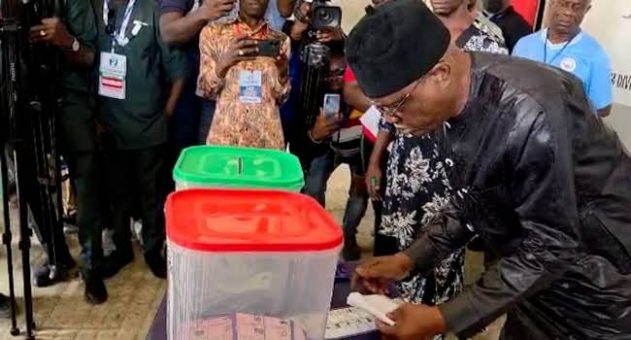
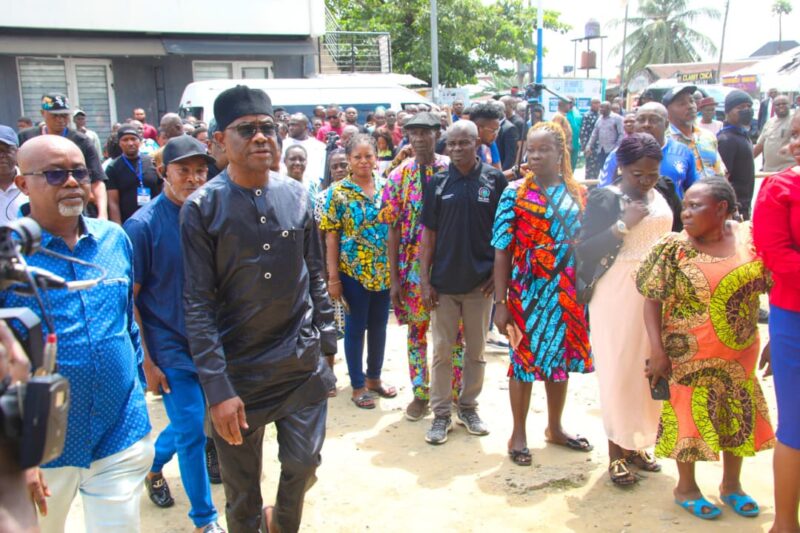
The suspended Governor of Rivers State, Siminalayi Fubara, and his loyal supporters were noticeably absent during the local government elections held on Saturday, a significant event for the state’s political landscape.
Despite the election taking place, albeit on a limited scale, Fubara was nowhere to be found in his hometown of Opobo Local Government Area.
Eyewitness accounts revealed that the governor did not make an appearance in the state, raising eyebrows among political observers. Prominent figures in Fubara’s circle, including Edison Ehie, the Chief of Staff to the Government House, and Dr. Tammy Danagogo, the Secretary to the Government, alongside the sacked 23 local government chairmen, also failed to show up at the election venues.
Members of the Simplified Movement, a socio-political group closely aligned with Fubara, were conspicuously absent from the voting centers, further emphasizing the lack of support for the election from his camp.
When electoral materials were dispatched to Fubara’s designated unit in Ward 5 of Opobo in Opobo/Nkoro Local Government Area around 11 a.m., there were optimistic indications that the beleaguered governor—who had recently reconciled with his political mentor, Nyesome Wike, Minister of the Federal Capital Territory—would exercise his voting rights.
However, as the clock ticked towards the conclusion of voting at approximately 3:30 p.m., Fubara remained absent, neglecting his constitutional duty.
Reports indicate that Fubara, unlikely to have returned to his Opobo hometown in time for the polling, had traveled to London ahead of the elections. This absence follows President Bola Tinubu’s declaration of a state of emergency in Rivers State on March 18 due to an ongoing political crisis between Fubara and Wike, who had garnered the support of the majority of state lawmakers.
Following this declaration, Tinubu suspended Fubara, his deputy, Ngozi Odu, and all elected members of the Rivers State House of Assembly for an initial six-month period and appointed Vice Admiral Ibok Ete Ibas (retd.) as the sole administrator to oversee state governance.
Tinubu’s controversial decision sparked a wave of condemnation throughout the country, drawing criticism from legal experts, politicians, and civil society organizations.
However, a reconciliation was eventually brokered between Wike and Fubara, culminating in an agreement that included the early conduct of local government elections that had previously been won by supporters of the suspended governor.
In the lead-up to the council elections, the Rivers State Independent Electoral Commission (RSIEC) released a comprehensive list of political parties and candidates cleared to contest in the elections, showcasing the political rivalry within the state.
Among the candidates were members of the People’s Democratic Party (PDP), the All Progressives Congress (APC), Labour Party, and several other parties. The list revealed that the PDP would vie for only three chairmanship positions, while the APC fielded a significantly larger slate of 20 candidates across the state’s 23 local government areas.
Wike’s political organization, now termed the Renewed Hope Agenda, expressed its optimism regarding the election process, asserting confidence in its anticipated success. Reports indicated that 20 council positions were claimed by the APC under the leadership of Chief Tony Okocha, with the PDP securing the remaining three positions.
These seats are reportedly located in Obio/Akpor—the home area of the FCT Minister— as well as in Port Harcourt City and Ogba/Egbema/Ndoni LGAs.
In another development, Wike publicly endorsed Fubara’s return to his gubernatorial position following the conclusion of the state of emergency on September 18, 2025. After casting his vote in Rumepirikom, Ward 9, Unit 007, of Obio/Akpor LGA around 11 a.m., Wike conveyed his belief that the conditions were now favorable for lifting the state of emergency, as both state and local governments were poised to have representation once again.
He said, “As far as we are concerned, this election is peaceful, people are trooping out, and at the end of the day, the election has been conducted successfully and peacefully.
“I do know that by September 18, the state of emergency will expire and the state assembly will come back to their job, and we will have a government at the grassroots level.
“The coast is clear for the state of emergency to be lifted, being that the state government has its representative and the local government has its representatives, so we are good to go.”
Wike also commended the turnout and conduct of the people in the council poll, saying it would restore democratic governance to the grassroots.
The minister, however, queried the non-usage of the Bimodal Voter Accreditation System for the poll, although he described the exercise as credible.
He explained that voter participation varied across areas, noting that residential and rural communities recorded higher turnout compared to commercial centres.
Meanwhile, empty polling units, voter apathy, a lack of original result sheets and non-availability of BVAS marred the poll.
On the election day, Sunday PUNCH observed that as of 10am, electoral materials had yet to arrive at various voting centres.
This delay, it was gathered, was due to logistics challenges faced by the Rivers State Independent Electoral Commission in Obio/Akpor, Port Harcourt City LGA, Emohua and others.
According to sources, there were also delays in distributing materials for the election at registration centres across the state, due to issues with manpower and sorting the materials.
While monitoring the election, our correspondents noted that there was a low turnout of voters for the election in city areas, while there was improved voting exercise in some rural areas, especially in the Gokana LGA of the state.




Fuel Price Reduced as Dangote Announces New Pump Rates

Dollar to Naira Exchange Rate Today, September 21, 2026

Petrol Prices Drop as Filling Stations Cut Pump Rates

Fresh Fuel Prices Emerge Nationwide as Nigerians See Changes in Petrol Costs

2027: Five APC Govs Secretly Supporting NDC

Govt Declares Monday, September 21 Public Holiday
BREAKING: Popular APC Chieftain Assassinated (PHOTO)

Dollar to Naira Exchange Rate Today, September 16, 2026

INEC Releases Numbers of Parties For Saturday’s Election
Anti-Corruption Boss Resigns; Reason Emerges