
Spotlights
Untold Story: The secret bond Between Buhari and Awujale of Ijebuland

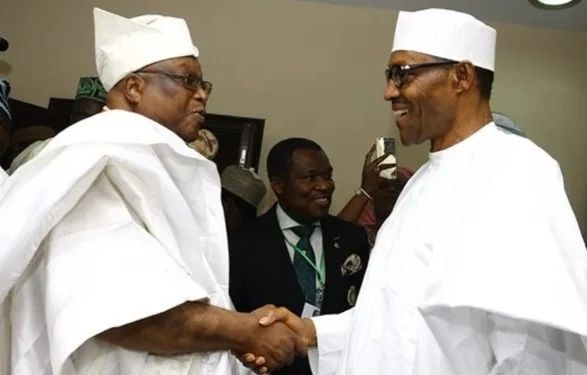
When news broke on 13 July 2025 that former President Muhammadu Buhari, 82, and the Awujale of Ijebuland, Oba Sikiru Kayode Adetona, 91, had died within hours of each other, many Nigerians were stunned less by the coincidence than by the depth of a friendship they barely knew existed.
Separated by profession, ethnicity, and geography, the ascetic ex-soldier from Daura and the outspoken monarch of Ijebu had, for decades, nurtured a bond that quietly shaped politics in both the North and South-West. Their synchronized departure invites a fresh look at how shared ideals and private back-channels can alter the nation’s course far from public glare.
The Awujale’s admiration first surfaced publicly on 15 January 2015, weeks before the election that returned Buhari to power as a civilian. In his Ijebu-Ode palace he declared, “I have confidence and trust in Gen. Buhari… corruption will be a thing of the past.” For a king who had just refused to endorse the incumbent, President Goodluck Jonathan, the statement was seismic. Both men were famously frugal, blunt, and allergic to graft, Buhari’s “War Against Indiscipline” of the 1980s mirrored the Awujale’s lifelong clashes with corrupt governors and military administrators. It was moral absolutism, not political convenience, that drew them together.

On the eve of the 2015 vote, Buhari’s courtesy call to the Ijebu palace softened Yoruba skepticism toward a northern ex-general. Ogun State later delivered one of his strongest South-West margins, a result party chieftains quietly ascribed to the Awujale’s nod. Nine months into office, Buhari returned the honour: he truncated an Ogun tour to spend twenty private minutes with the monarch, praising him as a leader “I will always honour.” In exchange the king pressed an old request the creation of Ijebu State and blessed Buhari’s anti-corruption crusade.
Photographs of a frail President Buhari in a London hospital bed, flanked only by APC stalwart Bola Tinubu and the Awujale, crystallised the alliance. Yoruba elites were already grumbling about cabinet appointments, yet the monarch’s visit signalled that at least one formidable voice in the South-West still had Buhari’s back.

From 2017 onward the friendship retreated even further from view. Palace aides recall late-night calls patched from Aso Villa to Ijebu-Ode whenever ethnic tempers flared after the #EndSARS protests, for instance. The public never heard of these consultations, but their fingerprints are visible: a camera-free stop at the palace during Buhari’s 2019 campaign, and a quiet federal release of funds to fix the Sagamu–Ijebu-Ode road in 2020, one of the king’s long-standing grievances. Insiders say the Awujale was one of only three non-family members who could reach Buhari directly at any hour.
Buhari celebrated the Awujale’s 89th and 90th birthdays in glowing terms, calling him “a chief who leads by example.” Conversely, Villa sources reveal that the file nominating the monarch for a Grand Commander of the Order of the Niger (GCON) began on Buhari’s desk but was only signed by President Tinubu in 2024. What Buhari could not deliver the promised Ijebu State remains a lingering footnote.
Yoruba mystics speak of kobiyeye, the passing of covenant friends within a narrow window. Historians, less mystical, nonetheless acknowledge the symbolism, two reputations for integrity launched, intertwined, and concluded almost in unison. Their deaths underscore how personal relationships, invisible to most citizens, can redirect regional loyalties, open discreet channels for ethnic grievances, and even soften the edges of Nigeria’s harsh partisan rivalries.
Legacy Beyond the Spotlight. The Buhari–Awujale alliance:
- bridged a trust gap between a northern candidate and a skeptical South-West electorate;
- offered Buhari a confidential Yoruba sounding board beyond partisan courtiers;
- demonstrated that value-based friendships, not just patronage, can bind Nigeria’s elite.
Yet questions endure. Did the Awujale’s early endorsement dull his later criticism of Buhari’s economic missteps? How deeply did palace counsel influence presidential decisions? Future biographers will need palace diaries, Buhari’s private papers, and NSA phone logs to trace the full arc.
For now, the evidence suggests that beneath Nigeria’s deafening political theatre, quieter alliances rooted in shared conviction rather than shared spoils sometimes do the heavier work of nation-building. Muhammadu Buhari and Oba Sikiru Kayode Adetona proved it. Their story only became news on the day they left the stage together, but its impact had been echoing, silently, for years.
straightfromnaija




Top Ex-APC Governor Resigns from ADC

BREAKING: Massive Fire Rocks Popular Nigerian Bank

Tinubu Announces Top Appointment for Popular Ex-Governor’s Son

PHOTOS: INEC Publishes Tinubu, Atiku, Peter Obi’s Certificates

BREAKING: INEC Removes Top Presidential Candidate from Election List(PHOTO)

Tragedy as Top Monarch Killed, Set Ablaze in Shocking Attack (PHOTO)

Ex-President Obasanjo Names Greatest Mistake of His Life, Video Trends

Jubilation as Nigerian Gov Declares Permanent 13th-Month Salary for Workers

Sad End as Former Deputy Governor Dies (PHOTO)
Governor Sacks Top Varsity Vice Chancellor
