
Spotlights
President Appoints Son as Vice president, Head of Armed Forces

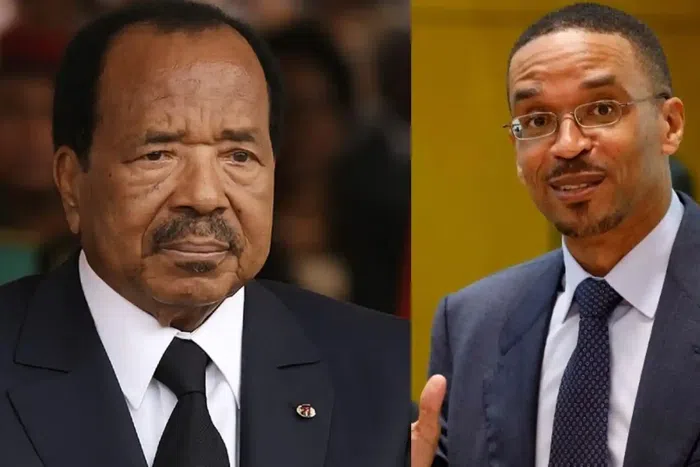
Cameroon’s President, Paul Biya, has appointed his son, Franck Emmanuel Biya, as Vice President of the Republic and Head of the Armed Forces.
This strategic appointment is seen as a means to enhance the President’s influence over the country’s political and military frameworks, particularly during a time of notable unrest.
The official announcement was made on April 4, 2026, via a decree that also names Franck Biya as Minister Delegate at the Ministry of Defence, placing him in a central position within Cameroon’s security infrastructure.
President Paul Biya sworn in for an eighth term on November 6, 2025
The document states: “Mr Franck Emmanuel Biya is appointed Vice President of the Republic of Cameroon.”
It further adds: “Mr Franck Emmanuel Biya is appointed Head of the Armed Forces.”
Expanding his role, the decree notes: “The Vice President of the Republic, Mr Franck Emmanuel Biya, is also appointed Minister Delegate at the Ministry of Defence of the Republic of Cameroon.”
Citing constitutional provisions and defence laws, the presidency said the appointments were made in line with “service requirements,” adding that the decree “shall be registered, published according to the procedure of urgency, and inserted in the Official Gazette.”
This move happened a few months after President Biya, who’s 92, officially began his eighth term – a term no one had ever held before. This all came about after a pretty controversial election, sparking protests across the country and drawing attention from the international community.
In that election, Biya got about 54% of the votes, beating out the main opposition candidate, Issa Tchiroma Bakary, who received around 35%. But Tchiroma Bakary doesn’t accept the results; he insists he actually won and says the government cheated, although the government firmly denies those accusations.
Despite the controversy, Biya described the election as “satisfactory” and commended the electoral body for its conduct, while congratulating security forces for containing the demonstrations without addressing allegations of excessive force.
The Constitutional Council dismissed multiple petitions challenging the results, citing insufficient evidence or lack of jurisdiction.
Biya, who took over as Cameroon’s leader in 1982 following the previous president, Ahmadou Ahidjo, is now finding himself under fresh fire from critics. They’re accusing him of trying to tighten his hold on power, using both political maneuvering and military strength.
Making his son the vice president and head of the armed forces is likely to raise further worries about who will take over leadership and how democratic the country really is, especially as demands for change keep growing louder.
A report from the Robert Lansing Institute for 2025 suggested that if Biya’s government aims to keep power within the family by having his son succeed him, Cameroon might end up with a simple handoff from father to son instead of any real political change. The report added that this scenario would probably require some behind-the-scenes adjustments to the constitution or rulings from the loyal Constitutional Council to clear Franck Biya’s path to power.
The report also pointed out that many Cameroonians are uneasy about the possibility of a “president-for-life” situation evolving into a family dynasty. As one advocate for social justice observed, “Biya’s strategy is all about keeping everyone uncertain.” The lack of openness, however, leaves the country feeling “unsure about what lies ahead,” and a secretive handover from father to son could stir up divisions within the country or widespread public anger.
Already, Cameroon’s political direction mirrors a regional trend where long-standing leaders amend constitutions and manipulate institutions to hold onto power indefinitely.




FULL LIST: 4 Tinubu’s Ministers Step Down

Petrol Prices Crash Across Depots as Marketers Import Fuel; New Depot Prices Emerge

Good News: Tinubu Makes Major Move to Solve Electricity Crisis

President Appoints Son as Vice president, Head of Armed Forces

INEC Finally Exposes How ADC Violated Electoral Act

Six Killed in Easter Church Attack, Army Rescues 31 Abducted Villagers

ADC Secretary Resigns; Gives Reason

Dollar To Naira Exchange Rate Today, April 6, 2026
Marketers Announce New Petrol Prices Across Nigeria; State-by-State Price Emerges

50 Houses Burnt in Fresh Northern Community Clash
