
News
Tinted Glass Permit: NBA, Police At War Over Enforcement

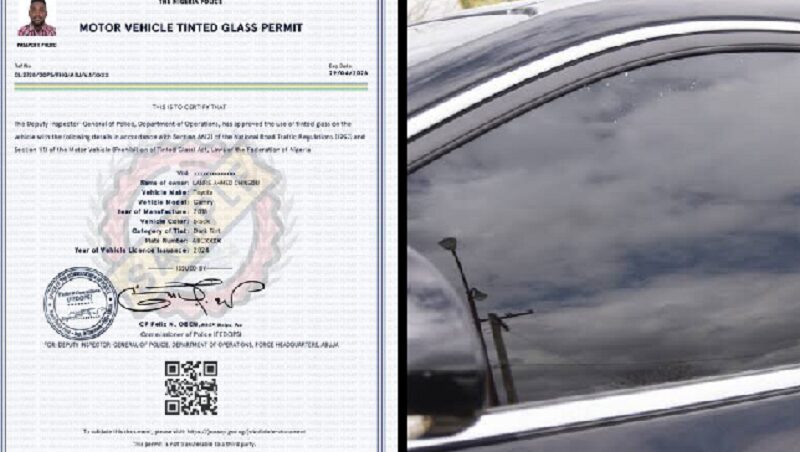
The Nigeria Police Force (NPF) recently informed the Nigeria Bar Association (NBA) that there is no court order currently in place that prohibits the enforcement of the Tinted Glass Permit policy.
Chief Superintendent of Police (CSP) and Force Public Relations Officer (FPRO) Benjamin Hundeyin made this announcement in Abuja during a press conference, addressing concerns following the NBA’s threat to file a contempt lawsuit against Inspector General of Police (IGP) Kayode Egbetokun.
This legal response from the NBA arose after the police reintroduced the enforcement of the tinted glass permit on Monday, after it had been suspended in October.
Hundeyin clarified that the court order referenced in discussions only mandated that the situation prior to the order be maintained, which did not include a halt to the enforcement of the policy that was already active at that time.
“We would like to put this on record. At no point did any court restrain the Nigeria Police Force from enforcing the tinted glass permit policy,” Hundeyin said.
The FPRO explained that the injunction did not grant the request seeking a halt to enforcement.
“What we have is people misinterpreting the last court document that was issued. That injunction spoke about maintaining the status quo. I don’t want to go into technicalities.
“At the time that order was given, enforcement was ongoing, and the court said the status quo should be maintained. In fact, the court stated specifically that the request by the lawyer who approached the court, seeking that the enforcement be stopped, would not be granted at that point. The document is out there. So, the status quo meant that enforcement, which was already ongoing, should continue,” he said.
Hundeyin explained that the subsequent suspension of the policy was not based on any court directive but resulted from consultations between the IGP and the NBA.
“However, we later had a meeting with the NBA, where the IGP decided to take the path of care, listening and concern, and consequently directed that the tinted glass permit policy be suspended. That suspension was not based on any court order.
“It was based on the Nigeria Police Force being responsible and responsive to the yearnings of the people, and responsive to the appeal by the NBA,” Hundeyin added.
The NPF spokesperson stressed that no timeline was attached to the suspension, adding that the Force had anticipated that the court case would be concluded within the period.
“When we announced that suspension, there was no time frame attached to it. At no point did we say it would last until a specific time.
“We simply suspended it at that point. In fact, we hoped that the court case would have reached a logical conclusion within that period. If you recall that statement, we said the policy was suspended to give Nigerians room to regularise their documentation and to await the outcome of the court case,” he said.
Beaming light on the decision to reinstate enforcement, Hundeyin said the prolonged legal process had created a security vacuum that criminals were exploiting.
“The case has dragged on, and during that period, criminal elements have confidently used tinted vehicles to perpetrate crimes,” he said, citing an incident in Benin City, Edo State, about two weeks ago.
“Just two weeks ago in Edo State, the police attempted to stop a Lexus SUV with fully tinted windows. The occupants refused to stop, and a pursuit ensued.
“When the vehicle was eventually stopped, it veered to a corner. As the police approached, the occupants opened fire on the officers. One officer died instantly — an inspector of police. They were able to do this easily because the vehicle was fully tinted. From the outside, you could not see that they were armed. This and many other cases underscore the issue. The mandate of the police is to protect life and property. We will not fold our arms and watch things degenerate,” he said.
Hundeyin also spoke on the NBA’s contempt threat, saying the police would respond through its Legal Directorate once formally served.
“We are yet to be served with any court papers. We will not act based on what you have just told us. Once any papers are served, we have a Legal Directorate.
“Once the papers arrive, we will respond accordingly. For now, it is hearsay, and I will not speak on hearsay,” he said.
Addressing concerns over revenue from the tinted glass permit process, Hundeyin stated that the current system differs significantly from the old manual process, as it is fully digital and hosted on a secure government platform.
“This system is a departure from the old tinted permit system, which was manual and paper-based. This time, the process is entirely online through a secure website,” he said.
Hundeyin added that the fees charged are used to maintain the database, security infrastructure, and advanced technology required to safeguard sensitive personal information.
“To operate a website or database that stores confidential information, such as phone numbers, NINs, home addresses, and dates of birth, you need additional layers of security. These do not come free or cheap,” Hundeyin said.
The FPRO said the system allows Nigerians in the diaspora to submit biometric data remotely, including photographs, facial scans, and fingerprints, stressing that such technology requires continuous investment.
“Security certificates, such as SSL and firewalls, require yearly renewal. Some may be one-off payments, but many require annual renewal.
“We are protecting Nigerians’ information with these advanced systems, and these systems require ongoing maintenance. That is what the fees are for—to run and sustain the database. It is not a money-making venture or a revenue-generating drive. It is about ensuring safety and security for Nigerians,” he said.
Hundeyin dismissed claims that the policy or its payment process was unlawful, stating that all necessary approvals were secured before implementation.
He said: “You can see that the website is a government website — posap.gov.ng. If anything were illegal, it would not carry a .gov.ng extension. The Federal Government itself created the website. All aspects of the system—the process, from beginning to end—were ratified by the government before it was launched.”




2027: Tinubu’s Ally Reveals Who Will Be Lagos’ Next Governor

SAD END: Another Lawmaker Dies After Brief Illness

ADC Plots Next Move as David Mark Holds Secret Meeting with Leaders of New Party

APC Pioneer Chairman Resigns from Party; Gives Reason

Ganduje Can’t Give Me Orders – APC Governor Takes Stand

Akpabio’s Daughter Gets Political Appointment

N3.6 Billion Laundering: EFCC Refuses to Back Down on Omatsuli Case

24 Dead, Worship Centres Destroyed in Deadly Assault in Kebbi – Catholic Diocese

Union Bank: How Controversial Transactions Led to CBN Takeover

Dollar Crashes Again as Naira Fights Back Strong
