
News
Genocide: China Backs Tinubu Amidst Trump’s Threat To Strike Nigeria

Following its designation of Nigeria as a ‘Country of Particular Concern’, the United States has said it will work with the Federal Government to take decisive actions aimed at arresting perpetrators of religious violence, protecting Christians, and rescuing those held hostage, as reported by The PUNCH.
The Chair of the United States Commission on International Religious Freedom, Vicky Hartzler — whose recommendation led President Donald Trump to blacklist Nigeria as a violator of religious freedom — disclosed this while welcoming the US leader’s decision.
Hartzler, in a statement, commended Trump for taking steps to address what she described as the persecution of Christians in Nigeria.
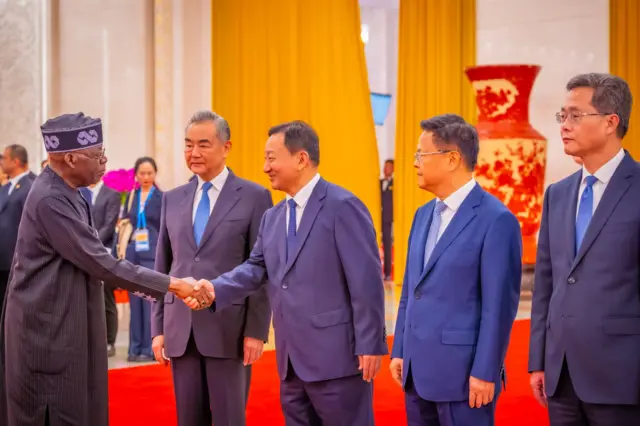
China, however, voiced strong support for Nigeria and criticised what it called foreign interference in the country’s internal affairs.
Trump had announced Nigeria’s designation as a Country of Particular Concern in a post on his Truth Social platform on Friday, alleging that Christianity in Nigeria faces an “existential threat” and claiming that thousands of Christians have been killed by radical Islamists.
He warned that the United States could take decisive measures — including possible military intervention — if the Bola Tinubu administration failed to act.
In its reaction, the Federal Government rejected the US claim, describing it as inconsistent with facts, and reaffirmed Nigeria’s commitment to combating violent extremism, protecting citizens, and promoting religious freedom and inclusiveness.
As part of its response to Nigeria’s alleged violations, the United States Congress is considering a bill that would impose severe sanctions on state governors, public officials, and non-state actors involved in enforcing the Sharia Penal Code.
The bill, sponsored by Republican Senator Ted Cruz, has passed second reading and been referred to the Senate Committee on Foreign Relations for further consideration.
The draft legislation, S. 2747, dated September 9, 2025, is titled ‘Nigeria Religious Freedom Accountability Act of 2025.’ It directs the US Secretary of State to designate Nigeria as a Country of Particular Concern, impose specific sanctions, and take other related measures.
The proposed legislation also targets terrorist groups and individuals implementing or supporting Islamic laws in the country.
Under the draft law, penalties would extend to judges, magistrates, prison officials, and other judicial or law enforcement officers found complicit in terrorism, corruption, or the enforcement of blasphemy laws.
It specifically includes anyone responsible for prosecuting, convicting, imprisoning, or otherwise depriving individuals of their liberty on charges of blasphemy.
Reacting to the executive action, the USCIRF chair, Vicky Hartzler, said, “USCIRF applauds President Trump for speaking out on the religious freedom crisis in Nigeria and making Nigeria a Country of Particular Concern.”
“The US Government can now develop a tough plan with Nigeria to ensure that perpetrators of violence are held to account, people of faith are protected, and those held hostage are rescued,” she added in a statement published on the commission’s website on Monday.
The USCIRF vice chair, Asif Mahmood, also told The PUNCH in an emailed response on Tuesday that the commission would ensure the Trump administration implements a series of executive actions against Nigeria, which it described as a serial violator of religious freedom since 2009.
During Trump’s first administration, the US State Department had placed Nigeria on its Special Watch List in 2019 and designated it as a Country of Particular Concern in 2020, citing recurring violent attacks against religious communities.
“The United States Commission on International Religious Freedom welcomes President Trump’s making Nigeria a Country of Particular Concern,” the statement read. “USCIRF has recommended this designation since 2009 because of the government’s engagement in and tolerance of systematic, ongoing, and egregious religious freedom violations.”
The statement cited several recent incidents, including the killing of at least 200 people — among them internally displaced persons — at a Catholic mission in Benue State in June, and the murder of at least 27 worshippers during an early-morning mosque attack in Katsina State in August.
“These and other violent incidents targeting religious communities are escalating tensions and threatening Nigerians’ ability to freely express their faith,” it added.
Mahmood noted that, in addition to violence by non-state actors, the Nigerian government must also be held accountable for allowing the enforcement of blasphemy laws in 12 states.
“Enforcing these laws and tolerating violence targeting Christians, Muslims, and other communities justify the CPC designation,” he said. “Now the administration can use this opportunity to impose Presidential Actions under the International Religious Freedom Act to incentivise needed change in the country.”
In his email to The PUNCH, Mahmood reiterated that Nigerian authorities had “repeatedly failed to address ongoing violence targeting religious communities.”
“In our 2025 Annual Report, which covered the calendar year 2024, we reported on violence targeting religious communities where Nigerian authorities far too often fail to adequately respond,” he wrote.
He explained that USCIRF uses international human rights standards, including the Universal Declaration of Human Rights, under the International Religious Freedom Act, to determine when to recommend a Country of Particular Concern designation for any government that “engages in or tolerates particularly severe violations of religious freedom.”
“Nigeria has met that standard since 2009,” Mahmood said, noting that 12 state governments continue to enforce strict blasphemy laws used to prosecute Christians, Muslims, and humanists for alleged insults to religion.
He added that the USCIRF, in its annual reports, had repeatedly recommended policy actions the US government and Congress could adopt to improve religious freedom conditions in Nigeria.
“Now that President Trump has named Nigeria a CPC, the International Religious Freedom Act empowers the US government to execute multiple Presidential Actions,” Mahmood said. “We encourage the administration to do so and not to waive these actions.”
On steps Nigeria could take to secure a reprieve, Mahmood explained that ending or significantly reducing “systematic, ongoing, and egregious” violations of religious freedom, as outlined in USCIRF’s Annual Report, was the key condition for removal from its list of Countries of Particular Concern.
“Our recommendation is based on international human rights law, facts on the ground, and our statutory mandate,” he stated. “USCIRF’s monitoring and reporting efforts are ongoing, and our next CPC recommendations will be included in our 2026 Annual Report, which is due to Congress no later than May 1 of each year.”
Beijing backs Tinubu
However, the People’s Republic of China has strongly criticised the US action against Nigeria, describing it as a flagrant interference in the country’s internal affairs.
At a press conference in Beijing on Tuesday, Foreign Ministry spokesperson Mao Ning said China stood firmly with Nigeria in pursuing its own development path and opposed the use of religion or human rights as tools for political pressure.
Her remarks, circulated by the Chinese Embassy in Abuja, read, “As a comprehensive strategic partner of Nigeria, China firmly supports the Nigerian government in leading its people on a development path that aligns with its national realities.
“We oppose any country’s interference in other nations’ internal affairs under the pretext of religion or human rights. We also oppose the wanton threat of sanctions or the use of force.”
Meanwhile, the Minister of Information and National Orientation, Mohammed Idris, said President Bola Tinubu was taking concrete steps to ensure the safety of lives and property across the country.
Speaking with State House correspondents after a meeting with the President at the Presidential Villa, Abuja, on Tuesday, Idris said his discussions with Tinubu included the recent US comments on Nigeria.
He noted that the President had called for calm, assuring Nigerians that his administration remains focused on strengthening national security and promoting unity amid growing international scrutiny.
“It’s a routine meeting that we always have with Mr President,” Idris said. “Of course, the issue of the US also came up, and we discussed that extensively.”
According to him, the President is “calm and taking a holistic view of the situation,” while working to ensure the international community better understands Nigeria’s ongoing efforts to maintain peace and security.
“Only last week, Mr President, in his desire to reinvigorate the country’s security architecture, appointed a new Chief of Defence Staff and other service chiefs. That tells you he’s been working seriously to ensure Nigeria remains safe for all,” Idris added.
He explained that the government was deliberately keeping its diplomatic tone measured while expanding engagement with international partners to clarify Nigeria’s position.
“We are opening channels of communication so that the international community understands what Nigeria has been doing and intends to do to address any domestic or international concerns,” he said.
Responding to calls for broader engagement with religious and community leaders, Idris said Tinubu had adopted a multi-pronged approach.




Tinubu’s 3rd Minister Resigns; Full Details Emerge

(FULL LIST): UK, France, Others Grant Approval for Nigerian Ambassadors

Fresh Tension as Defence Minister Told to Resign
Accountant-General Resigns from Cabinet (FULL DETAILS)

APC Governor Sacks 300 Officials in Fresh Move

Dollar to Naira Exchange Rate Today, March 31, 2026

2027: Two Top Ministers Resign from Tinubu’s Cabinet

Top Minister Resigns as Tinubu Makes Fresh Appointment

After 24 Years, Ex-FCT Minister Dumps PDP

Tinubu’s Minister Resigns; Details Emerge
