
Foreign
500-year-old cannon that could fire ‘like a swarm of hornets’ found in Arizona. See it

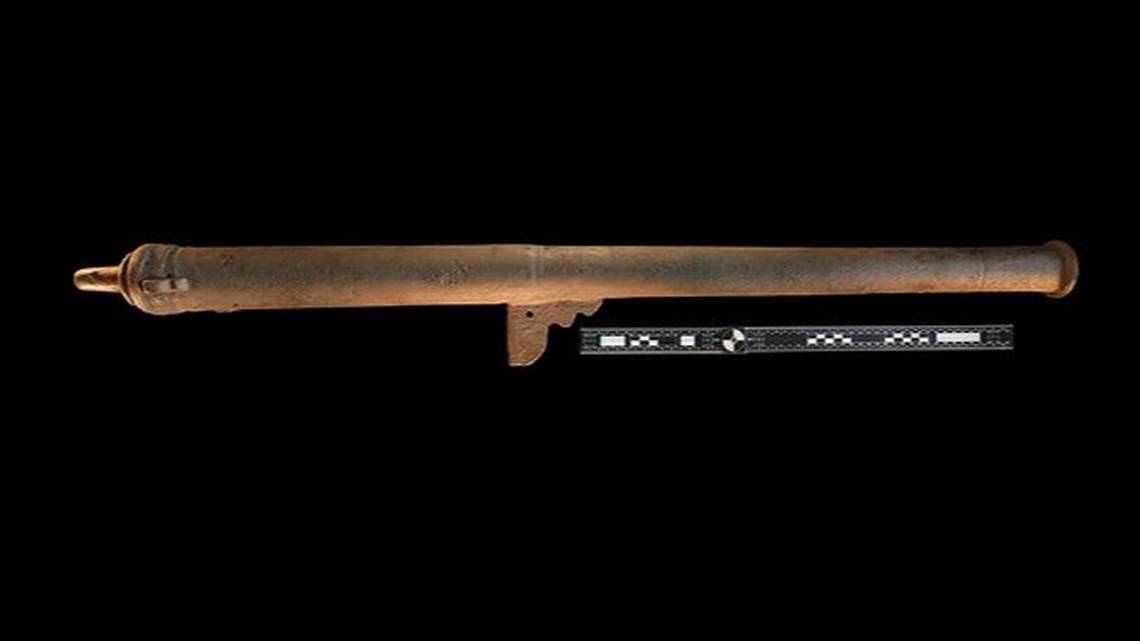
A centuries-old cannon has been discovered in southern Arizona – and officials say it’s the oldest firearm unearthed in the continental U.S.
The 40-pound bronze cannon, or wall gun, is believed to have been part of the Francisco Vázquez de Coronado expedition, archaeologist Deni J. Seymour and historical arms specialist William P. Mapoles wrote in the International Journal of Historical Archaeology.
The weapon could fire solid round projectiles or buckshot, and facing down a maximum load of pellets would be like an attack by “a swarm of hornets,” the article said.
The cannon likely was built after 1500 or 1520, and its metal “indicates that it was made here in the New World,” Seymour told McClatchy News in a phone call.
Recommended for you
Stray bullet kills NC 81-year-old grandpa eating cereal on New Year’s Day
Emerald green artifact was ‘ignored’ for 80 years. It was a ‘rare’ 500-year-old find
Treasure-filled cave held weapons — including dart thrower. See 1,900-year-old finds
It was discovered in 2020 in an eroded Spanish adobe-and-rock-walled structure along the Santa Cruz River, the article said.
The journal article was published online Nov. 21, and it’s set to appear in a print edition in 2025.
Coronado was a Spanish conquistador, and the expedition set off from Mexico in 1539.
It was the first European expedition in the region, the article said.
The wall gun is described as 42 inches long and about 40 pounds, with a bore that’s .95 inches in diameter. It’s “an important artifact,” the article said, “and is, no doubt, the earliest known surviving firearm in the United States and one of, if not the earliest found in a reliable context in the New World,” it said.
The firearm was found at what’s believed to be the site of San Geronimo III, a town set up by members of the Coronado expedition. The town was attacked by the Sobaipuri O’odham people, which was significant in more ways than one, the article said.
The attack was “the earliest, most consequential Native American uprising in the continental U.S.,” and it had long-lasting ripple effects, the article said.
“While there were successful battles elsewhere, as local Natives resisted the hard tactics and foreign ways of the Spaniards and other Europeans, this is a circumstance where Native resistance had lasting effects, causing the Spanish to abandon their settlement and interests in what would become southern Arizona for another 150 years,” the article said.
It appears the cannon wasn’t fired in the battle that routed the expedition from San Geronimo III. That’s based on lack of black powder residue in the barrel and other factors, the article said.
Seymour said a similar cannon that was fired in the battle has since been discovered nearby, and she’s working on publishing research on that find.
Interest in the Coronado cannon has been high, she said.
While people may be fascinated with the technology or mechanics of the firearm, “I think it’s an excellent means by which you can draw people into history,” she said.
The Herald




JUST IN: Another Senator Dumps PDP, Gives Reason

Ronaldo Leaves Saudi Arabia for Madrid

BREAKING: Tinubu Reshuffles Cabinet as Finance Minister Redeployed

Delta APC Split Widens as Big Names Snub Congress

Fresh Trouble for Naira as Dollar Picks Up Again

Dr. Olusola Ojo Hails Senator Bamidele’s ₦200M Annual Commitment to Ekiti University

Expert Fears Nigeria Could Be America’s Next Military Focus

EXPOSED: Security Agency Publishes Full List of Items Recovered in El-Rufai House

Dollar to Naira Black Market Exchange Rate Today, Tuesday, March 3rd 2026

Former President Confirmed Dead
